

From our experience advising business owners, investors and founders in Malaysia, one of the most common questions we receive is:
The answer is not about which structure is “better”, but what you are trying to achieve, whether it is running a business, structuring a deal, or scaling for growth.
In practice, we often see business owners setting up the wrong type of entity from the outset, usually based on cost or convenience rather than long term planning. This only becomes an issue later when the business expands, investors come in, or disputes arise.
Getting the structure right at the beginning is not just a legal step. It is a business decision that affects control, funding and future growth.

(1) Key Features of Each Entities
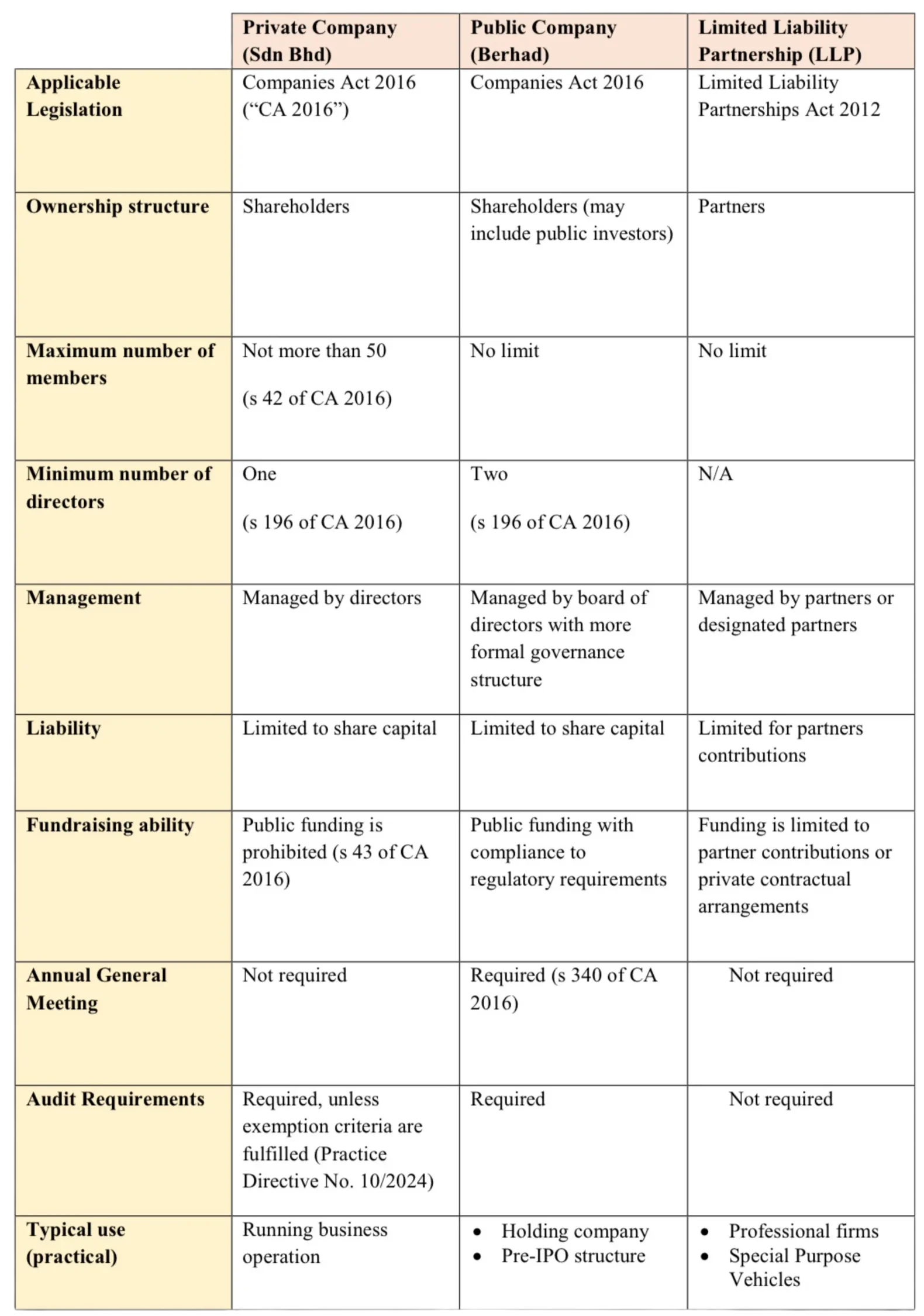
To better understand the differences, the key features of each entities are summarised below.
(2) Practical Structuring Approach
While the differences above set out the legal distinctions, the more important question is how these entities are actually used in practice.
In practice, these entities are not mutually exclusive and are often used in combination, depending on the stage of the business.
(a) Sdn Bhd is the default choice for most businesses.
At the startup stage, where the focus is on running day to day operations, hiring employees and building the business, a Sdn Bhd remains the most practical and widely accepted structure.
It is also suitable where funding is raised privately from persons already connected with the company, including family members, existing shareholders, employees or existing debenture holders (s 44(4) of CA 2016).
Where funding is sourced from friends, it is not specifically recognised under the CA 2016, and whether it constitutes private or public funding may be determined by the court on a case to case basis.
That said, the limitation on the number and nature of members may restrict fundraising flexibility, which may in turn limit the pace of expansion.
(b) Berhad is a strategic structure for growth.
Even where unlisted, a Berhad is commonly used as a holding or pre-IPO vehicle, particularly where there is an intention to raise funds from a wider pool of investors or prepare for a future listing.
However, the compliance and regulatory requirements applicable to a Berhad may be burdensome for SMEs, MSMEs and early-stage startups. As such, it is not typically adopted at the initial stage of a business.
(c) LLP is typically used for specific arrangements.
LLPs are more commonly used for professional firms, as well as collaborations or project-based structures, where flexibility in profit sharing is required.
Structuring an LLP as a special purpose vehicle may help address certain limitations of a Sdn Bhd, particularly in situations involving limitations on members or bespoke commercial arrangements.
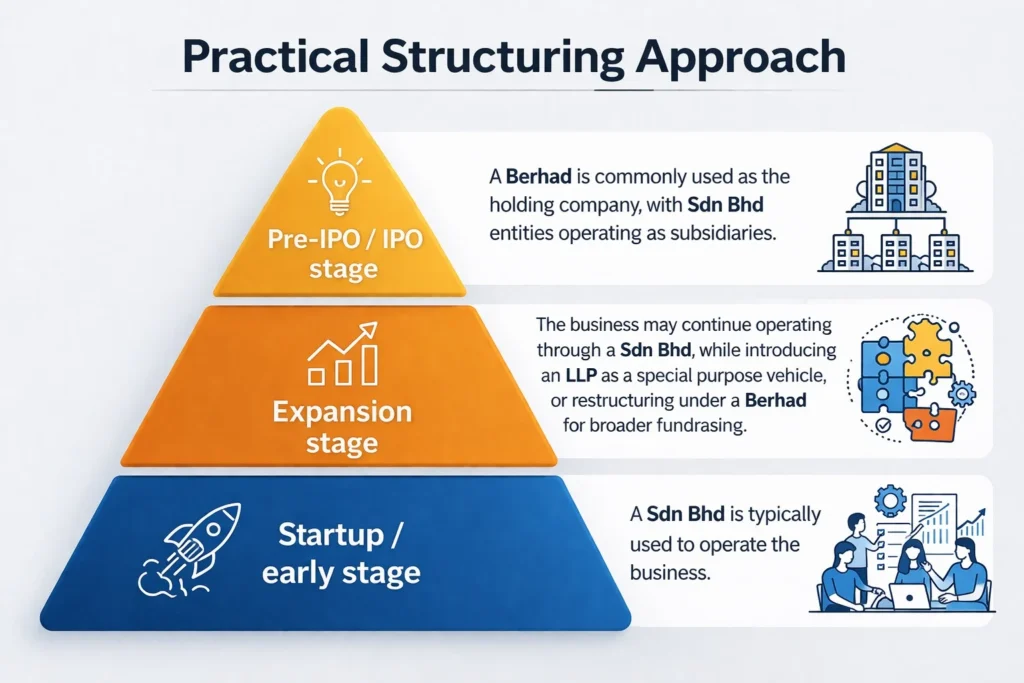
There is no single “correct” structure. The appropriate approach depends on the business objectives, funding strategy and long term plans.
From our experience, a well considered combination of Sdn Bhd, LLP and Berhad at the appropriate stages can provide the necessary balance between operational efficiency, flexibility and scalability.
Getting it right from the beginning can save significant time and cost in the future.
Disclaimer: This article is for general information purposes only and does not constitute legal advice. Specific advice should be sought based on the facts and structure of each transaction.
