

The legal system is often seen as complicated, expensive, and time-consuming. For smaller monetary disputes, pursuing a claim through the usual court process may not seem worthwhile, especially when legal fees can exceed the amount in dispute.
That is where the Small Claims Court comes in. Designed for straightforward, lower-value claims, it offers a faster, simpler, and more affordable way for individuals to resolve disputes without the need for lengthy legal proceedings.
The defining feature of a Small Claims Court is its limited jurisdiction. This means the court only has the authority to hear specific types of cases up to a strictly enforced monetary ceiling.
What it cannot do: Small Claims Courts cannot grant equitable remedies. They cannot order someone to perform a specific action, issue an injunction, or handle complex matters like divorces, wills, and defamation lawsuits.
The Small Claims Court is fundamentally designed for the public. It acts as an equalizer, ensuring that financial constraints do not lock ordinary citizens out of the legal system.
The Plaintiff
Any regular citizen or individual who is aggrieved can file a suit as a plaintiff. This also includes sole proprietors and members of business partnerships trying to recover commercial debts. However, strict limitations exist for larger entities: in many jurisdictions, incorporated private limited companies (Sdn. Bhd.) or Limited Liability Partnerships (LLPs) are completely barred from initiating a small claim as a plaintiff.
The Defendant
You can file a claim against almost any individual, business, or corporation that you believe owes you money. While a corporation usually cannot sue in this court, they can absolutely be sued as a defendant.
The “No Lawyers” Rule
The most unique rule of Small Claims Court is the ban on legal representation. Both the plaintiff and the defendant must step up and speak for themselves. You are fully permitted to consult a lawyer outside of court to prepare your case, but during the actual hearing, attorneys are not allowed to stand up and argue on your behalf.
Because the goal is speed and accessibility, the entire timeline moves significantly faster than a traditional trial.
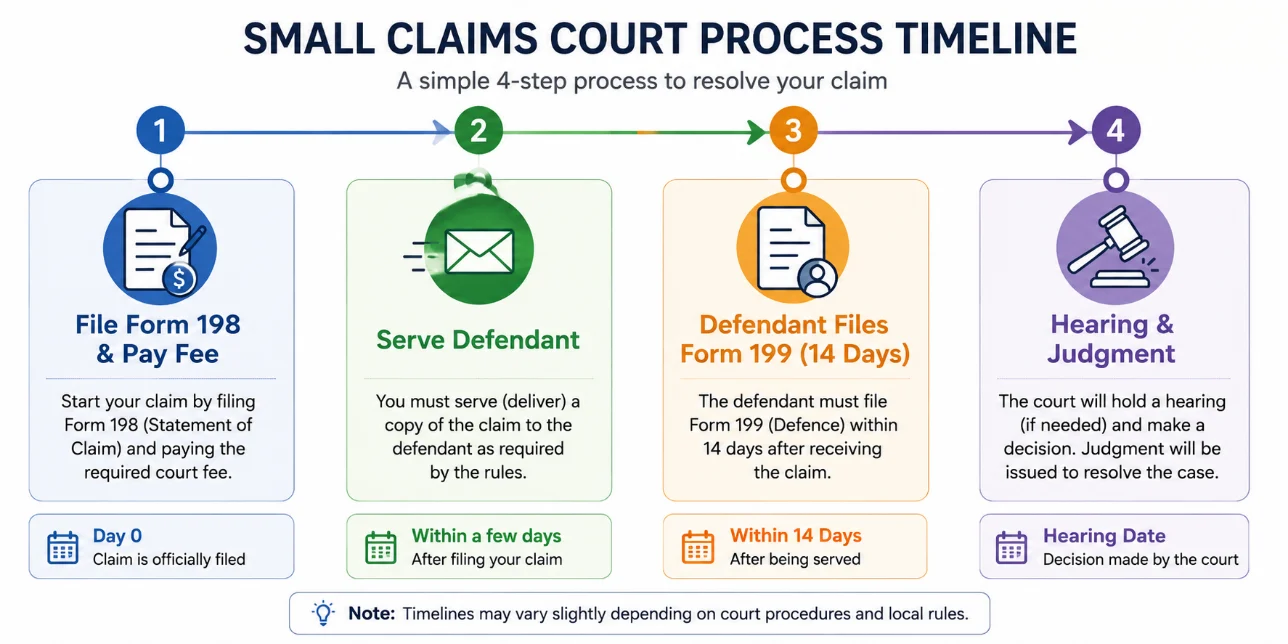
The process begins when the plaintiff completes a claim form (Form 198). This form requires a clear, concise statement of the facts, the exact amount owed, and supporting documentation. After paying a nominal filing fee at the court registry, the plaintiff must formally serve the sealed papers to the defendant via personal delivery or prepaid registered post.
Once served, the clock starts ticking. The defendant generally has 14 days to respond using a defense form (Form 199). If the defendant ignores the notice or fails to show up, the court can instantly issue a Judgment in Default in favor of the plaintiff.
If a defense is filed, both parties are called to a hearing before a Magistrate. The atmosphere is structured but informal. The Magistrate acts inquisitorially—asking direct questions to cut through the noise. You must bring all your evidence: receipts, text messages, contracts, and any witnesses. After listening to both sides examine the evidence, the Magistrate will make a final decision. In this venue, the decision is typically final, leaving no room for a costly appeal process.
Winning your case and getting a piece of paper signed by a Magistrate is a victory, but the court does not automatically collect your money for you. If the losing party (the Judgment Debtor) refuses to pay voluntarily, you must initiate enforcement proceedings.
| Enforcement Option | How It Works |
| Show Cause Notice (Form 208) | The court orders the debtor to appear and explain their financial situation, often resulting in a court-mandated installment plan. |
| Writ of Seizure and Sale | A court Sheriff or bailiff is authorized to seize the debtor’s physical property and sell it at an auction to pay off your debt. |
| Garnishment/Committal | Courts may also direct third parties (like employers or banks) to divert funds, or order brief imprisonment for contempt. |
The Small Claims Court strips away the intimidating jargon and high costs of standard litigation. By understanding these core operational pillars, you can confidently navigate the system to recover what is rightfully yours.
Disclaimer: This article is for general information purposes only and does not constitute legal advice. Specific advice should be sought based on the facts and structure of each transaction.
